
Financial advisor lead generation is the process of creating and converting qualified opportunities for an advisory practice. A durable system combines several channels—referrals, centers of influence, search and education, events, and targeted prospect research—then measures which ones produce the right first meetings.
The operative word is system. A purchased list can supply names. It cannot define your ideal client, create trust, explain why the prospect should talk to you, or show whether the channel is improving. Those jobs require a clear audience, a repeatable path to conversation, disciplined research, and a feedback loop.
unknown nodeWhat counts as a financial advisor lead?
A lead is not every person whose name appears in a database. For planning purposes, use three stages:
- Inquiry or identified prospect: a person has raised a hand, been referred, attended something, or matched a documented audience.
- Qualified opportunity: there is a plausible fit, a legitimate contact path, and a next action the firm is permitted and prepared to take.
- First meeting: the prospect accepts a conversation about their needs and the firm's ability to help.
This prevents the top of the funnel from becoming a vanity count. Ten thousand unverified contacts can be less useful than 25 people connected to a defined specialty, place, or relationship path.
Demand for advice is not disappearing. The U.S. Bureau of Labor Statistics counted 326,000 personal financial advisor jobs in 2024 and projects 10% growth from 2024 through 2034. That projection describes employment, not guaranteed demand for any individual practice, but it does show an expanding and competitive profession (BLS Occupational Outlook Handbook, retrieved August 16, 2026).
Start with the client you are built to serve
Lead generation gets expensive when every adult with assets looks qualified. Define the audience before the channel.
A usable ideal-client profile includes:
- Planning problem the practice is equipped to solve
- Life or business context, not merely an asset threshold
- Geography and service model
- Minimum complexity or economics required by the practice
- Clear reasons the prospect would choose this firm
- Disqualifiers that save both sides an unnecessary meeting
Schwab's 2025 RIA Benchmarking Study found that participating firms with a written marketing plan, ideal-client persona, and client value proposition reported 67% more new clients and 68% more new-client assets than firms without that combination. The study included 1,288 Schwab-custodied RIAs and was self-reported and observational, so it shows an association, not proof that documentation caused the growth (Schwab Advisor Services, July 16, 2025).
The practical lesson is modest: if the firm cannot describe a good-fit client, no tool can reliably find one.
Build a portfolio of lead-generation channels
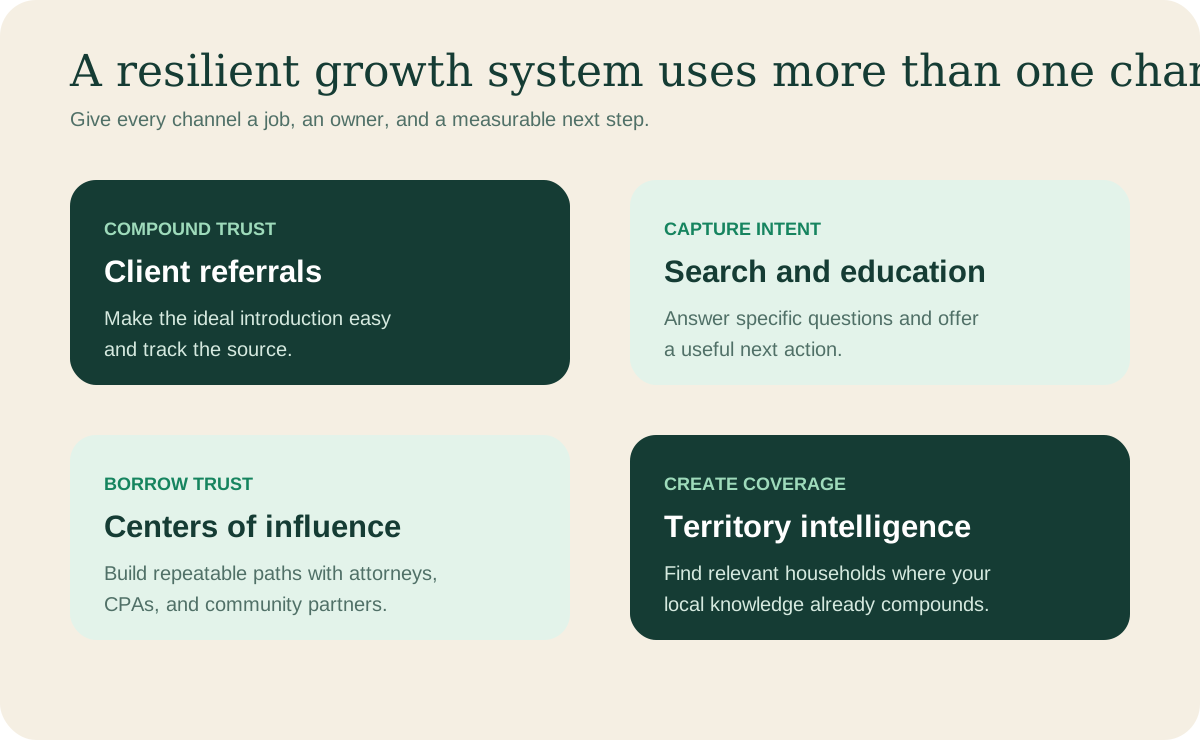
Each channel should have a distinct job. The mix reduces dependence on any single source without pretending every channel performs equally.
Use a small channel portfolio rather than attempting every marketing tactic at once. A solo advisor might run one compounding channel, one demand-capture channel, and one targeted discovery channel.
- Compounding trust: client referrals and centers of influence
- Capturing demand: search, educational content, and high-intent landing pages
- Creating relevant coverage: events, professional communities, and territory research
- Selective outbound: carefully researched introductions approved under the firm's policies
The 2026 Schwab study found that more than 70% of its Top Performing Firms tracked general prospect inquiries, compared with 58% of other participating firms; 85% tracked inquiry source, compared with 71%. Top Performing Firms were the top 20% on a 15-metric index, and the study's 1,236 firms were Schwab-custodied and self-reported. The result supports measurement discipline, not a universal formula (Schwab Advisor Services, July 15, 2026).
Keep referrals central—and make them operational
Referrals are strong because trust travels with the introduction. They become unreliable when the strategy is “do good work and hope someone mentions us.”
Schwab's 2024 benchmarking analysis attributed 67% of new clients and new-client assets among participating firms with at least $25 million AUM to client and center-of-influence referrals. That is a vendor study of Schwab-custodied RIAs, not a universal channel share (Schwab Advisor Services, September 19, 2024).
Fidelity's 2024 Investor Insights Study points in the same direction from an investor sample. Among people who had recently hired or switched advisors, 32% cited a friend or colleague referral, while 23% cited online search. The online survey included 2,100 investors with at least $50,000 in household investible assets, including 696 millionaires, and fieldwork ran in late 2023 (Fidelity Institutional, copyright 2025).
Turn referrals into a process:
- Identify clients for whom the firm has created clear value.
- Describe the situation or person the firm helps best.
- Ask at a relevant moment instead of mass-emailing every client.
- Make introductions easy and non-pressuring.
- Record the source, response, fit, and outcome.
- Thank the introducer without revealing private details.
Referrals should compound trust. They should not become a scripted extraction exercise.
Build repeatable paths with centers of influence
Centers of influence—such as CPAs, attorneys, benefits professionals, and business advisors—can create durable two-way relevance when the relationship is based on complementary expertise.
Start with a narrow client problem. An advisor serving business owners may build relationships around succession, tax planning, estate structure, or benefits. The useful question is not “Who can send me wealthy clients?” It is “Where do our clients repeatedly need coordinated expertise?”
Create a simple operating rhythm:
- Share a clear client profile and service boundary.
- Establish how introductions will be handled.
- Produce one useful educational asset together.
- Review anonymized patterns rather than private client details.
- Track introductions and outcomes in both directions.
Compensation, testimonials, and endorsements can create regulatory obligations. The SEC's marketing rule applies to SEC-registered or required-to-register investment advisers and sets conditions around compensated endorsements and testimonials (SEC small-entity compliance guide, April 28, 2021). Let compliance determine whether and how a specific arrangement can operate.
Capture active demand with useful search content
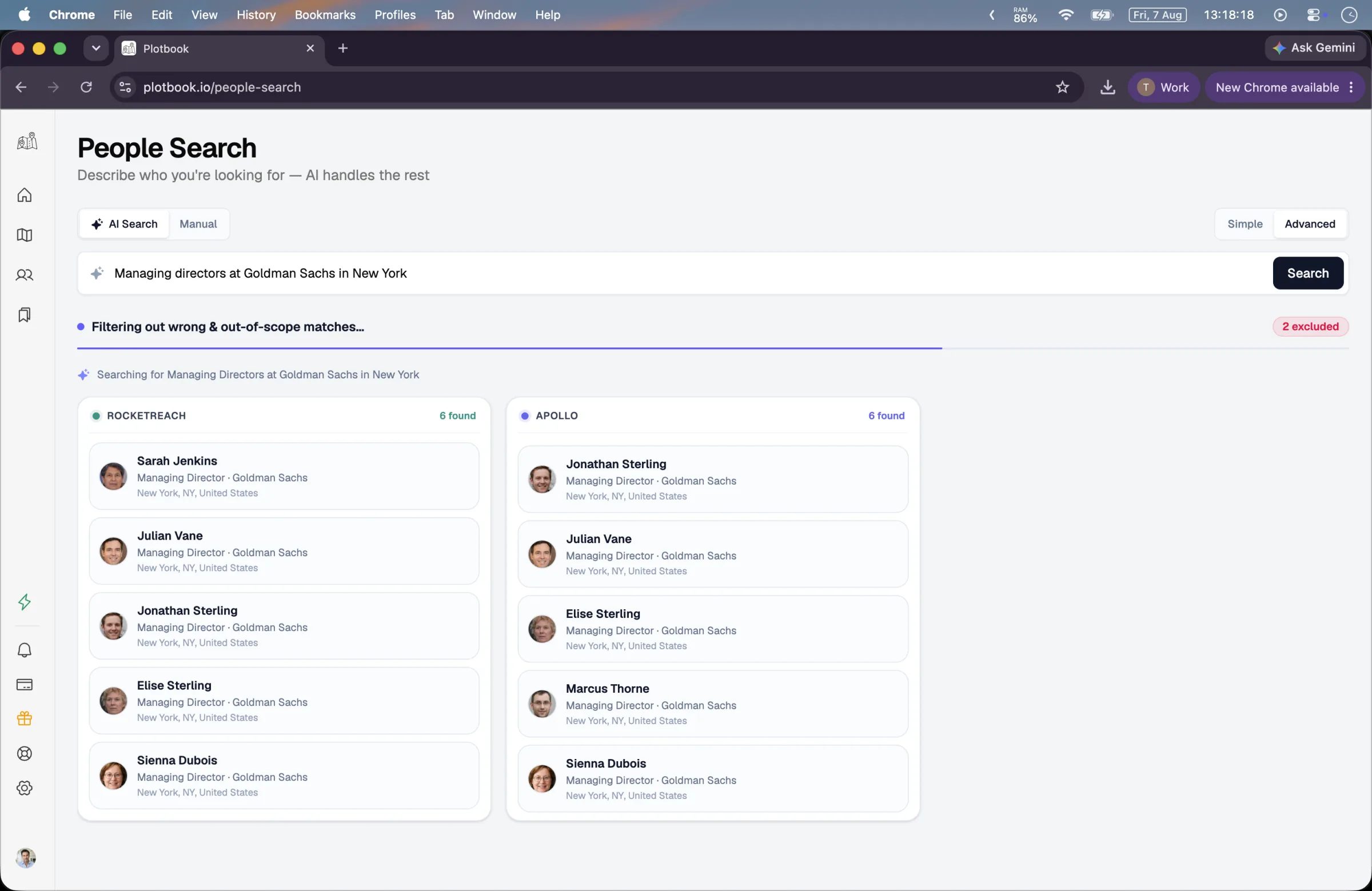
Product tools can help research a defined audience. The audience and reason to engage still come from the practice's strategy.
Search works differently from interruption. The prospect is already asking a question. Your job is to answer it accurately and provide a proportionate next step.
Useful content usually sits close to a real decision:
- How to evaluate an advisor after selling a business
- What to bring to a retirement-income planning meeting
- Questions to ask before transferring a concentrated stock position
- How couples can prepare for a first financial planning meeting
- What an executor should organize before discussing inherited assets
Avoid generic articles written only to contain keywords. Publish a specific answer, show the limits, identify the author, and connect the reader to one next action. Search is a compounding asset only when the content earns trust.
Use the same principle for webinars and seminars. Choose one audience and one problem. The event should create an informed opt-in, not serve as a pretext to collect a roomful of vague contacts.
Add territory intelligence when geography is an advantage
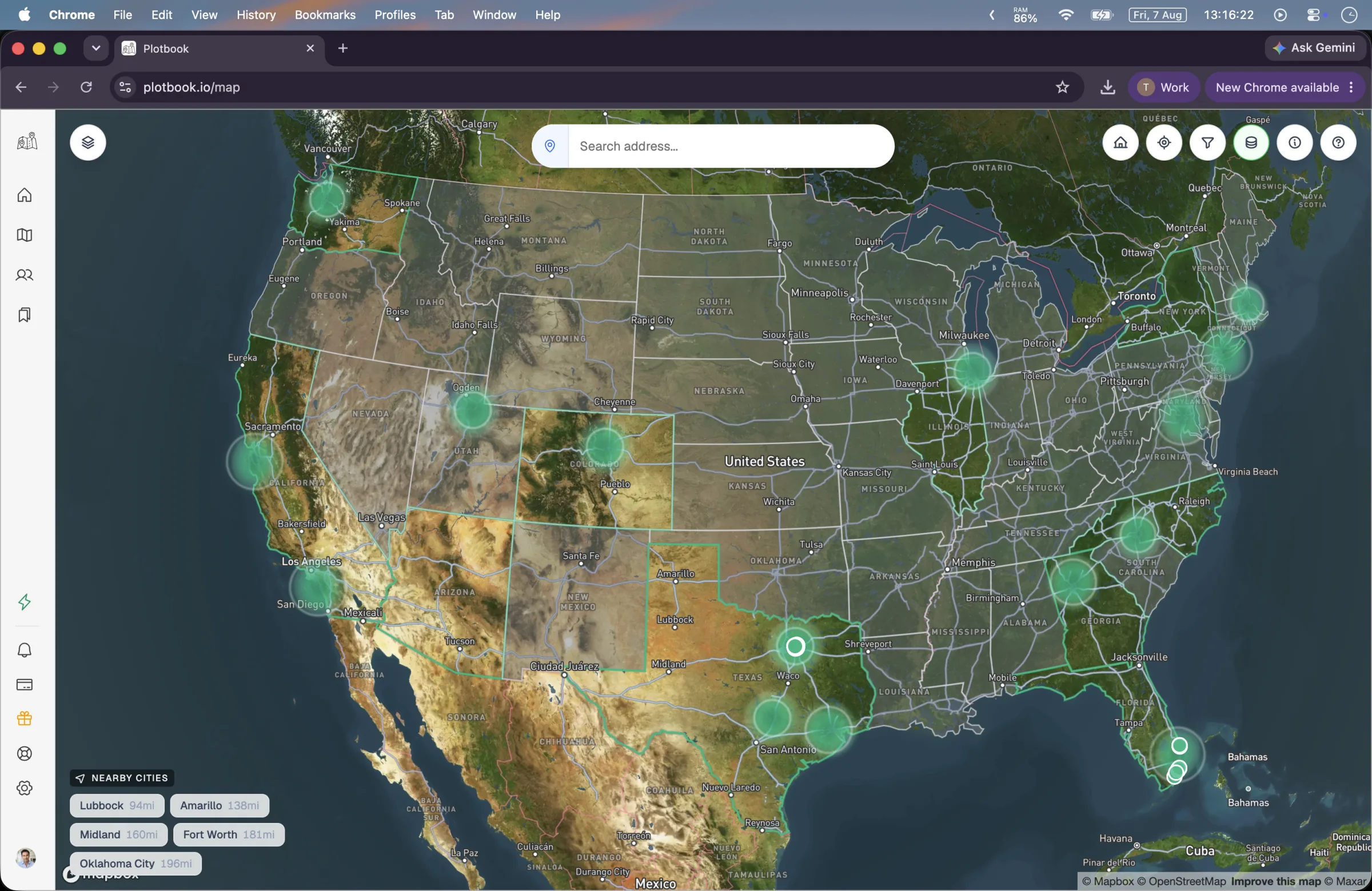
Territory intelligence starts from a place the advisor can actually work, then moves toward owners and relationship paths.
Property-first prospecting is useful when the practice knows a place better than it knows a list of names. A neighborhood, ZIP code, event radius, or business corridor can define a bounded research universe.
The workflow is:
- Define the territory.
- Use assessed-value bands and ownership records to identify relevant parcels.
- Resolve owners and entity-held property carefully.
- Add professional, household, and wealth context.
- Look for a legitimate relationship path.
- Prioritize a short list for human review.
This is a discovery method, not proof of liquidity. Home value, equity, net worth, and investible assets are different. See the full comparison of property-first and list-first prospecting and the methodology behind range-based wealth estimates.
In Plotbook, the property wealth map uses nationwide parcel data from Regrid, colors parcels by assessed-value band, and shows the owner of record. A selected property can route to instant owner lookup or deep research for LLCs and trusts.
Turn research into a usable prospect book
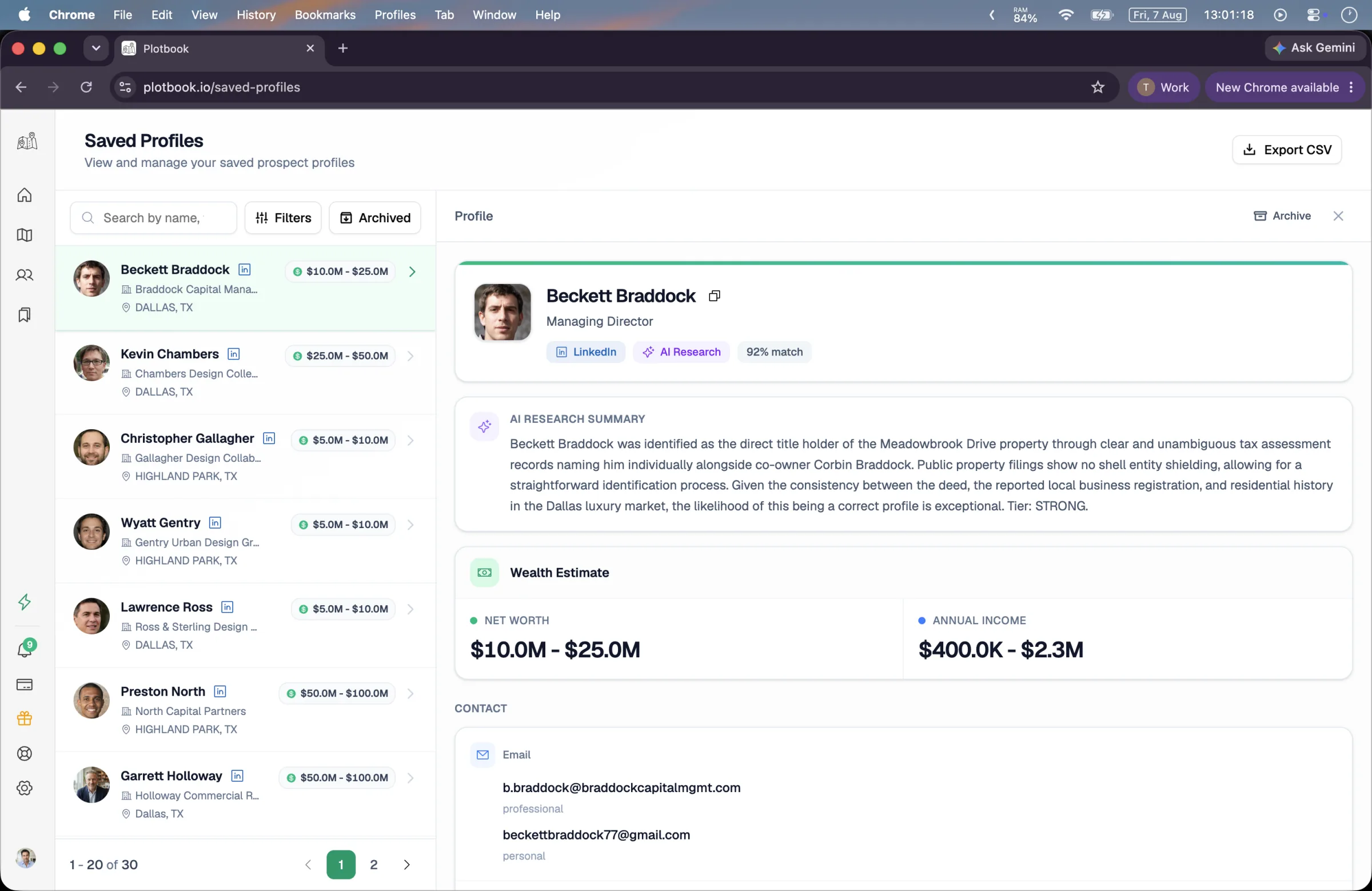
A prospect book should retain source and context, not collapse every signal into one score.
Whichever channel creates the lead, standardize the record. A usable prospect brief should include:
- Identity and disambiguating details
- Source channel and date
- Reason the person may fit the ideal-client profile
- Relationship or permission path
- Relevant public facts and their sources
- Open questions and uncertainty
- Next approved action and owner
Do not invent precision. A high property assessment does not prove investible assets. A job title does not prove income. An LLC filing does not necessarily name a beneficial owner. A useful record separates known facts from inferences and unknowns.
Plotbook's saved profiles keep contact details, source, research summary, notes, linked properties, and wealth ranges with a confidence score. Profiles can come from map lookup, AI owner research, or people search.
Export only the fields the next system needs
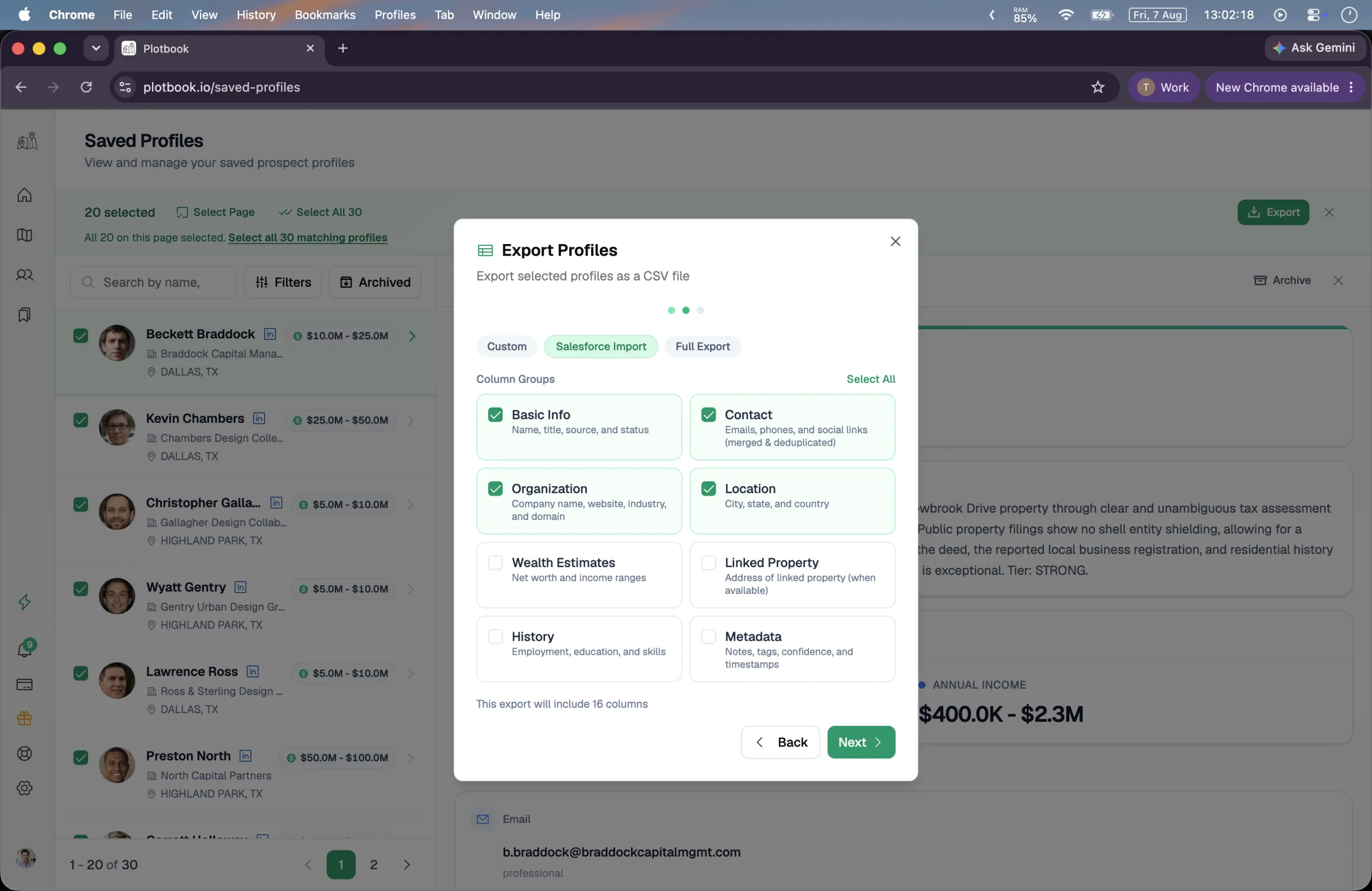
The product exports a CSV with selectable fields; it does not claim a live CRM integration.
Moving every available field into a CRM creates clutter and expands the amount of personal data your firm must govern. Export the fields required for the next approved workflow.
For example, a first-review queue may need name, source, location, fit reason, relationship path, notes, and next action. Contact fields should enter an outreach system only when the firm has decided they are appropriate for that channel.
Plotbook's Professional and Enterprise plans can generate a CSV with selectable field groups and a Salesforce-ready preset. The file downloads through a time-limited link. This is an export, not a two-way CRM sync.
Measure the funnel and the work required
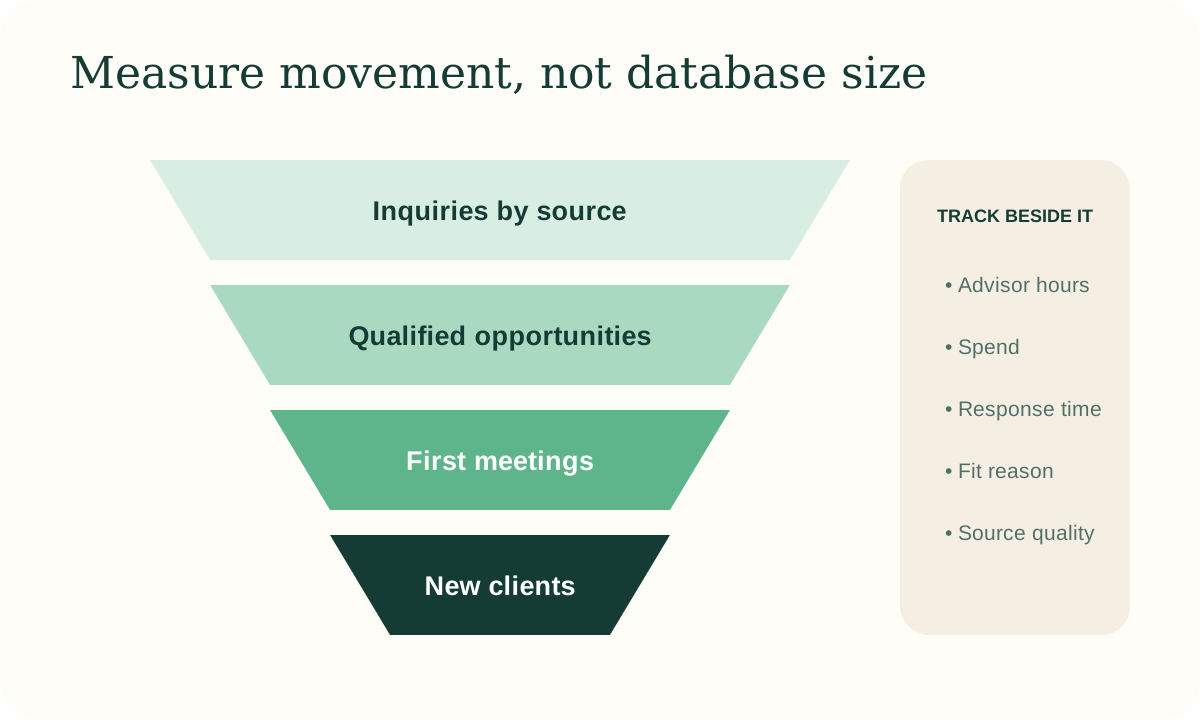
A channel earns more budget when it produces fit and movement at a reasonable cost in money and advisor time.
Track these metrics by source:
- Inquiries or identified prospects
- Qualified opportunities
- First meetings booked and held
- New clients
- Time from identification to first response
- Advisor and staff hours
- Direct spend
- Primary loss reason
Do not change the qualification rule halfway through a test. Run two channels for the same period with equal advisor-time limits, then compare movement and fit. Small practices often discover that a “cheap” channel is expensive in research and follow-up time.
The broader RIA market is large but skewed toward smaller firms. The Investment Adviser Association reported 16,544 SEC-registered advisers in 2025; 92.8% employed 100 or fewer people, and advisers focused on individual clients averaged eight employees. Those figures come from Form ADV data and include many business models, but they reinforce why the system must be operable by a small team (Investment Adviser Association, 2026 Industry Snapshot, retrieved August 16, 2026).
Keep research and outreach inside the compliance process
Research does not grant permission to call, email, text, or advertise. Before launching a channel, document the governing policy, required approvals, suppression lists, recordkeeping, and vendor responsibilities.
FINRA Rule 2210 defines and governs correspondence, retail communications, and institutional communications for member firms, with supervision and recordkeeping requirements depending on the communication (FINRA Rule 2210, retrieved August 16, 2026). The FTC's telemarketing guidance also directs covered sellers and telemarketers to maintain written procedures, train staff, honor entity-specific requests, and use an updated National Do Not Call Registry for covered calls (FTC Telemarketing Sales Rule guide, retrieved August 16, 2026).
This article is not legal advice. State law, registration status, firm policy, channel, audience, and message content can change the analysis.
A practical 90-day lead-generation plan
Days 1–15: define and instrument
Write the ideal-client profile, disqualifiers, value proposition, stage definitions, and metrics. Baseline current referrals and inquiries. Confirm the approval path with compliance.
Days 16–45: launch two channels
Choose one trust channel and one discovery or demand channel. Examples: documented referrals plus a high-intent article, or COI outreach plus a bounded territory pilot. Put a weekly time cap on each.
Days 46–75: improve fit and follow-up
Review why opportunities advanced or stalled. Tighten the audience, answer the questions that repeatedly block action, and improve the handoff from research to first meeting.
Days 76–90: reallocate deliberately
Compare meetings, fit, clients, advisor hours, and spend. Increase investment only where the channel produced useful movement. Keep a small experiment slot instead of rebuilding the entire plan each quarter.
Frequently Asked Questions
What is the best lead-generation method for financial advisors?
There is no universal best channel. Referrals are often strongest when the practice already has satisfied clients; search captures active demand; centers of influence borrow relevant trust; and territory research helps a local practice discover households outside its existing network. Choose by audience, permission path, economics, and measurable results.
Should a financial advisor buy leads?
Buying leads can make sense only when the firm understands exclusivity, source, consent, qualification, replacement terms, expected staff time, and compliance obligations. Compare the channel on held meetings and acquired clients—not the seller's lead count.
How many lead-generation channels should a solo advisor run?
Usually fewer than they think. One trust channel, one demand or discovery channel, and a small experiment are enough to learn without fragmenting follow-up. Capacity and consistent execution matter more than channel count.
What should advisors track first?
Track inquiry source, qualification, first meetings booked and held, new clients, advisor hours, spend, and the reason opportunities did not advance. If the source and stage are missing, later attribution will be guesswork.
Can property data identify high-net-worth prospects?
Property data can help prioritize research because it connects a person or entity to a real asset. It cannot prove home equity, total net worth, annual income, or investible assets. Use it as one signal and corroborate the person and financial context.
Build the learning loop
The best financial advisor lead generation system is not the one with the largest database. It is the one your firm can explain, operate, supervise, measure, and improve.
Define fit. Give each channel a job. Preserve the source trail. Measure movement and advisor effort. Keep uncertainty visible. Then move resources toward the channels that repeatedly create the right conversations.
If geography is one of your advantages, start with Plotbook's map-first prospecting workflow and build a short, researched prospect book before deciding how—or whether—to reach out.