

A $4 million house can be easy to find and hard to attach to a human. The parcel record might name WENTWORTH RESIDENCES LLC, a trust, or a limited partnership. That record is useful, but it does not tell you who lives there or who controls the entity.
The mistake is treating the first plausible name as the answer. A defensible LLC property owner lookup is an evidence trail: classify the owner of record, follow the entity and its addresses, corroborate the people you find, and stop when the sources do not support a conclusion. If you are starting with a home rather than a company, property-first prospecting is the broader workflow this research supports.
This guide explains a public-record research process for legitimate business use. It is not legal advice, and it does not promise that every entity can be resolved to a natural person.
unknown nodeWhat an LLC on a property deed actually tells you
The deed identifies the legal owner of the property. If the owner is an LLC, the deed has done its job. It has not promised to name the person behind the company.
People hold property in entities for many reasons, including privacy, estate planning, liability separation, or shared ownership. The entity itself is not evidence of unusual wealth or suspicious activity. It simply changes the research path.
You now need to answer two separate questions:
- Which person controls or is associated with the entity?
- Is that person also connected to this property strongly enough to act on?
The first question is corporate research. The second is identity disambiguation. Skipping either one is how a commercial registered agent, an attorney, or someone with the same name ends up in a prospect list.
Start with the complete parcel record
Capture more than the entity name. A useful parcel record includes:
- The exact owner name as recorded
- The site address
- The tax-bill mailing address
- The parcel ID
- The deed or transfer references available from the county
- Assessed value and use type
- Any owner-occupancy or homestead indicator the county publishes
The tax-bill mailing address can be one of the most productive fields in the record. If it differs from the property address, it gives you another place to test. That address might lead to an office, a different residence, a family member, or another entity. None of those is proof by itself, but each can produce the next corroborating source.
County assessors and recorders vary. One county might expose deed images and mailing history online, while another provides only a basic parcel card. Keep the parcel ID and legal owner spelling intact so you can move between systems without losing the thread.
King County, Washington, illustrates why the identifiers matter. Its recorder index does not maintain a street-address field. Researchers must first resolve the address to a parcel number, then search recorded documents by parcel, grantor or grantee, or instrument number (King County Recorder's Office, retrieved August 16, 2026). Your county may work differently, but the division of labor is common: the assessor helps identify the parcel and taxpayer, while the recorder holds deeds and transfer documents.
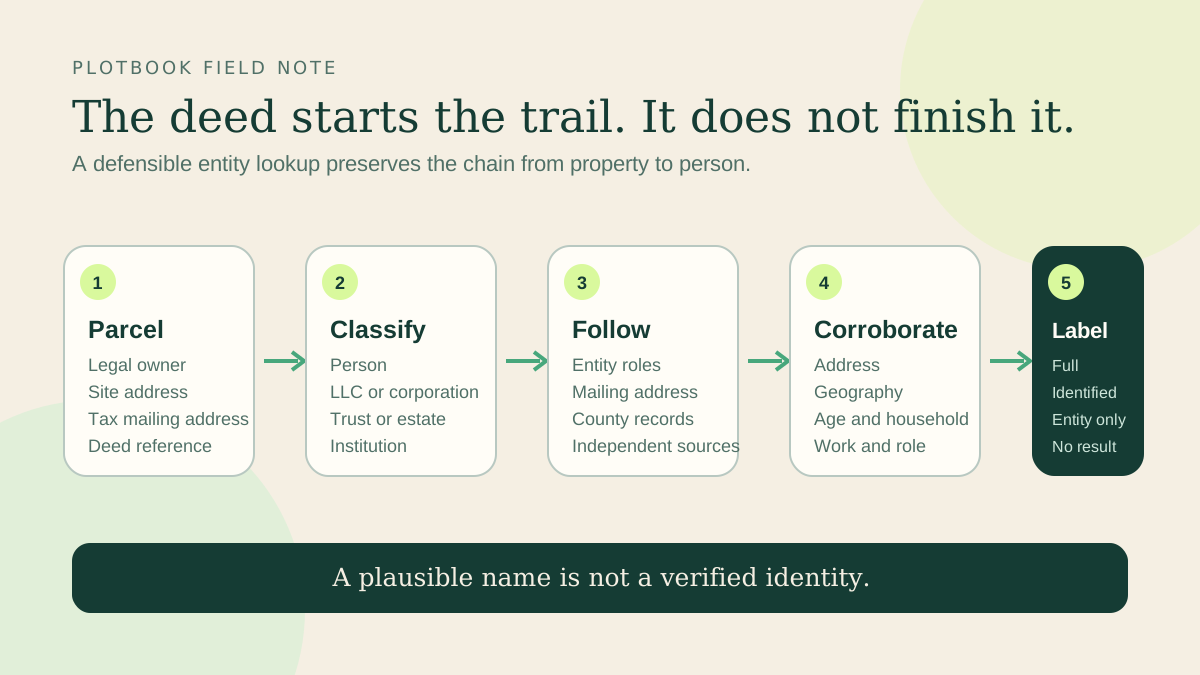
The workflow preserves the chain from parcel to entity to person. Each stage can produce a useful result without guaranteeing the next one.
Search the entity before searching for a person
Search the full legal entity name first. Do not start with the neighborhood and guess at residents.
For an LLC or corporation, look for records and credible references that name:
- Members or managers
- Officers or directors
- Organizers
- Business addresses
- Prior names or related entities
- Filing dates and status
Registry aggregators can help you discover possible records, but they are not all primary sources and they can lag. Where a state filing is available, open it. Record the role attached to each person instead of turning every name into "owner."
An organizer filed the formation paperwork. An officer has a corporate role. A manager may control an LLC. A registered agent accepts legal notices. Those roles can overlap, but the label alone does not prove beneficial ownership of the property.
LLC disclosure depends on the state and the filing
There is no uniform 50-state answer to "Are LLC owners public?" The fields, filing cadence, and public access rules depend on where the entity was formed and which document you are reading.
A May 2026 U.S. Government Accountability Office review found that states may collect officers, directors, LLC managers, or members, but those names may not be the beneficial owners or the people exercising substantial control. GAO examined federal rules and a six-state sample, so the finding demonstrates variation rather than defining every state's exact requirements (GAO-26-107967, May 29, 2026).
|
Illustrative state |
What the public filing may reveal |
What it does not settle |
|---|---|---|
|
Delaware |
LLC name, registered office, and registered agent are mandatory formation fields |
Member names are not mandatory under the formation statute |
|
Texas |
Initial managers for a manager-managed LLC, or initial members for a member-managed LLC |
The listed governing person can be another organization and may not show current ownership |
|
California |
The Secretary of State says comprehensive legal ownership and shareholder information are not part of its record |
|
|
New York |
The requirement is transaction- and property-specific, not a universal LLC directory |
These are examples, not a legal survey. Start with the official registry for the entity's jurisdiction, read the form instructions, and capture the date. California LLC statements, for example, are generally filed every two years, which means a valid public filing can still lag a real-world change (California Secretary of State, retrieved August 16, 2026).
When a filing names another company as manager or member, repeat the entity search. Do not declare the chain resolved because the second entity has a more human-sounding name.
Do not mistake the registered agent for the property owner
This is a common false positive in entity research.
Commercial registered-agent companies appear across thousands of unrelated entities. Law firms and formation services can appear for the same reason. Their presence in a filing tells you where legal notices go, not who owns the house.
Treat a registered agent as a routing clue unless another independent source connects that person to the entity and the property. If the filing points only to a commercial agent, pivot to the entity's mailing address, county deed history, business website, press coverage, or other public records.
Some states disclose less about LLC members than others. A clean research process needs an honest outcome for those cases: the entity is identified, but the human is not.
Delaware law makes the distinction especially clear. A registered agent is the designated recipient for legal process and official communications, and the registered office need not be the LLC's place of business (Delaware Code, Title 6 §18-104, retrieved August 16, 2026). The agent listing alone does not demonstrate that the agent owns, controls, or occupies the property.
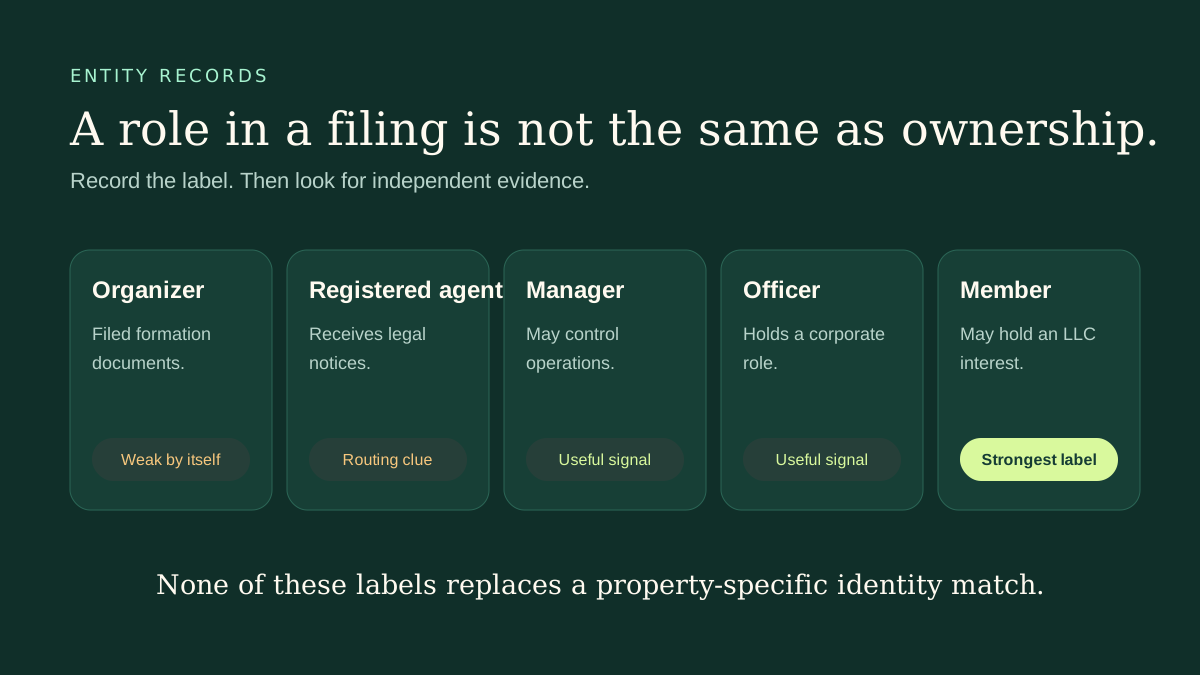
A member or manager label can be a strong lead. No role label replaces a property-specific identity match.
Federal beneficial-ownership data is not a public shortcut
Do not build the workflow around the assumption that FinCEN offers a public beneficial-owner search.
Current FinCEN guidance says entities created in the United States and their beneficial owners are exempt from Corporate Transparency Act reporting under the interim final rule published March 26, 2025. The GAO estimated that the change removed more than 99% of previously covered entities from the federal reporting requirement (GAO-26-107967, May 29, 2026). Even when beneficial ownership information exists at FinCEN, access is restricted to specified government, regulatory, and financial-institution users under defined conditions. General commercial search is not authorized (FinCEN BOI guidance, retrieved August 16, 2026; FinCEN Access Rule fact sheet).
This area changes quickly. Recheck the agency guidance before publication and do not describe federal BOI reporting as a database available to advisors.
Use the mailing address as a second research surface
Compare the property's site address with the tax-bill mailing address.
If they match, the entity may still hold an owner-occupied home. Search the address for residents, then test each possible person against the entity.
If they differ, research the mailing address separately. It may reveal:
- Another residential property associated with the same household
- A business office where the entity and a principal overlap
- A trust administrator, attorney, or accountant who should not be treated as the owner
- A generic mailbox or commercial agent address that provides no human link
The mailing-address pivot is valuable because it comes from the property record itself. It is still only a lead. A matching address becomes persuasive when another source also connects the same person, entity, and geography.
Match people with corroboration, not confidence theater
A plausible name is not a verified identity. Before attaching a person to an entity-owned property, look for agreement across multiple attributes:
- Current or prior city
- Age range
- Residential address history
- Employer or business affiliation
- Spouse or household member
- Entity role
- Reporting that names the buyer or resident
The evidence should form a chain. For example, a manager named in a business record, a matching tax-bill address, and an independent professional profile in the same city are materially stronger than a single people-search result.
Name matching alone is weak, especially for common names. A polished profile does not repair a bad identity match.
The practical test is whether the identity still holds after you remove the most convenient source. If the conclusion disappears when one aggregator, address, or filing is removed, the evidence is probably too thin for a CRM.
Trusts and estates require different labels
An LLC playbook does not transfer cleanly to every owner type.
For a trust, the public record may name a trustee. The trustee administers the trust and is not automatically the person who lives at the property or benefits from it. Keep trustee and principal roles separate.
For an estate, look for an executor, personal representative, or probate record. An heir or family member may eventually be relevant, but the deed alone rarely settles that question.
For banks, governments, homeowners associations, and large institutions, the correct answer may simply be that there is no individual prospect to resolve. Stopping is part of good research.
Use outcome tiers so uncertainty survives the handoff
The final record should say how far the evidence got. A simple four-level model works:
- Full profile: The person is identified and the available sources support usable contact and background details.
- Identified: The person is identified, but contact or background data is incomplete.
- Entity only: The legal owner is clear, but no human can be supported.
- No result: The sources do not support either a useful entity or person resolution.
Do not flatten these outcomes into found or not found. An entity-only result can still save the next researcher from repeating the same dead end. It also prevents a low-confidence guess from entering a CRM as fact.
A manual LLC property owner lookup workflow
You can run this process without specialized software:
- Pull the parcel card and deed references from the county.
- Record the legal owner and tax-bill mailing address exactly.
- Classify the owner as a person, LLC, corporation, trust, estate, partnership, or institution.
- Search entity filings and record every person's stated role.
- Reject commercial registered agents as owners unless independent evidence says otherwise.
- Research the site and mailing addresses separately.
- Corroborate possible people across address, geography, age, and work.
- Save the sources and assign an outcome tier.
The work gets slower when records span counties, the deed names another entity, or the state does not disclose members. That is the part a research system can reduce. It cannot remove the need for judgment.
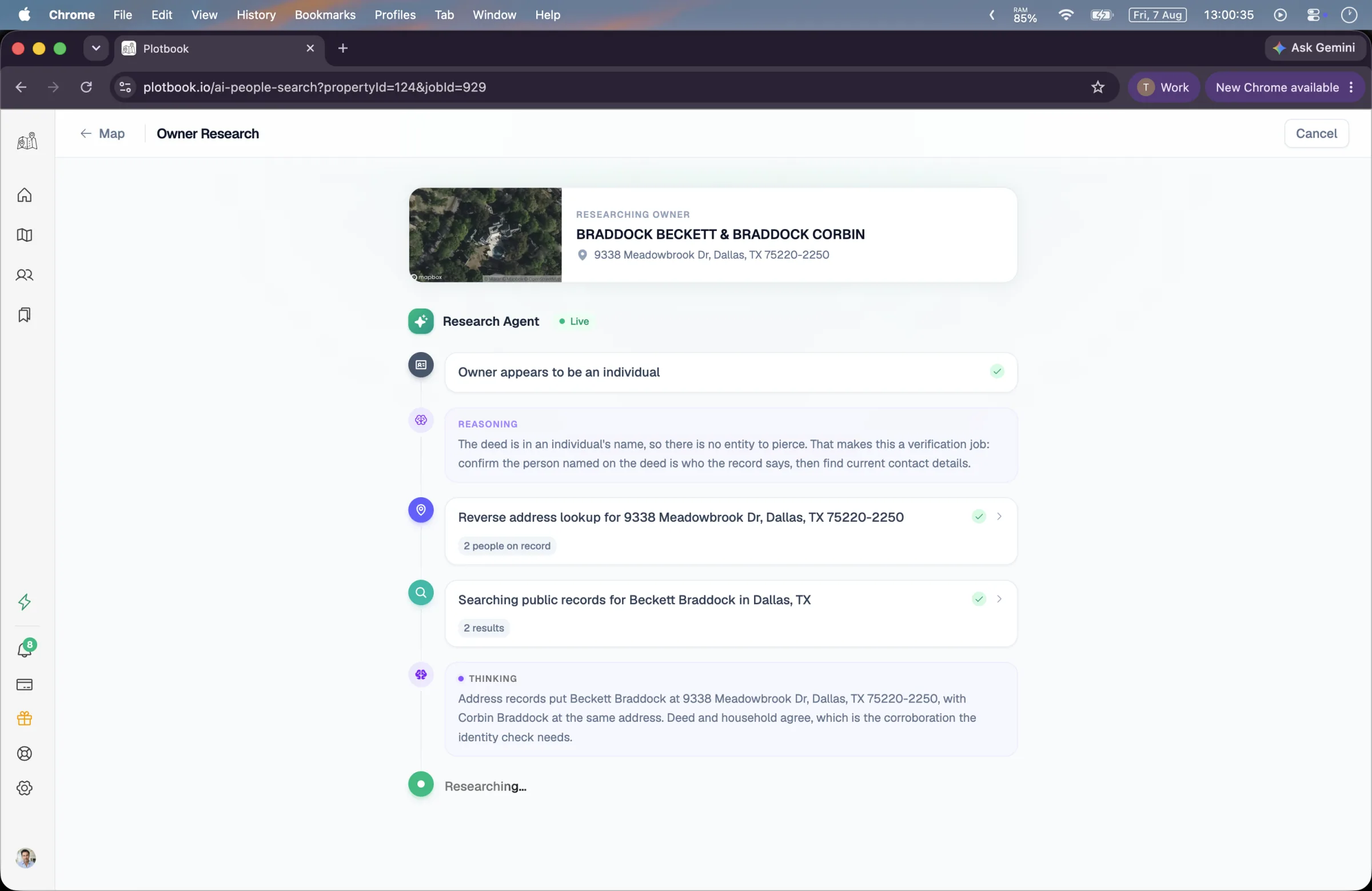
Plotbook interface with illustrative demo data. The timeline keeps the research steps visible instead of collapsing them into one unexplained name.
How Plotbook handles entity-owned properties
Plotbook AI Owner Research starts with the parcel and classifies the deed owner before it searches for people. LLCs, corporations, trusts, estates, partnerships, and institutions follow different research paths.
The workflow checks business references, county property records, the tax-bill mailing address, residential records, professional sources, and public contribution records where relevant. It requires corroboration before committing to an identity and shows the research activity and source links as the work runs.
Research continues in the background, so you can leave the page and return to the result. A successful deep research run costs 25 credits. Failed, canceled, no-result, and institutional searches are not charged.
The useful distinction is not manual versus AI. It is sourced research versus a plausible guess. Whichever method you use, preserve the chain from deed to entity to person.
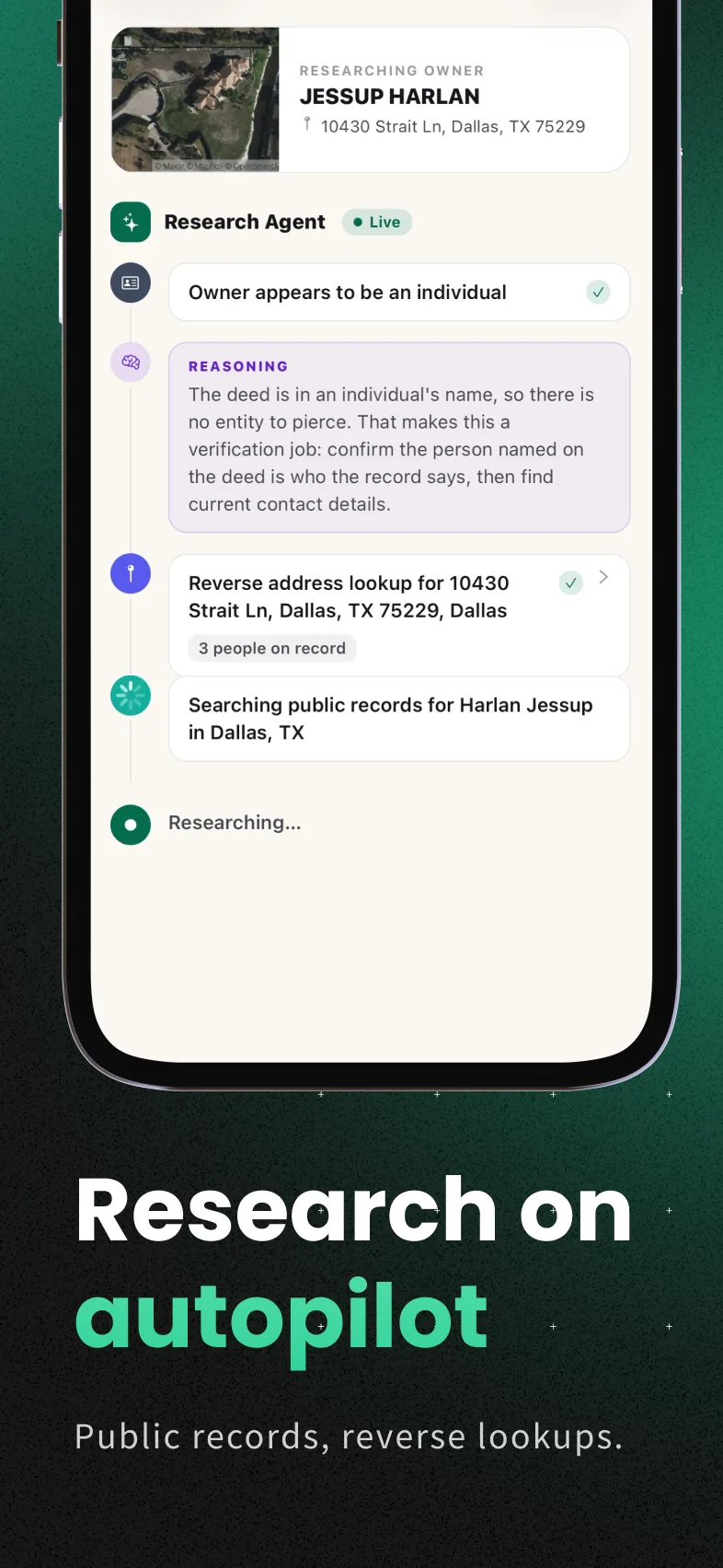
Illustrative product visual. On iPhone, the research run continues in the background and returns through a notification when it finishes.
Continue the property-to-person trail in Plotbook
If entity deeds are a recurring part of your territory work, open Plotbook AI Owner Research to see how the parcel, owner classification, live source trail, and final profile stay connected. You can also inspect an illustrative result in the Plotbook sample report before starting a trial.
Frequently asked questions about LLC property owners
Can a county assessor tell me who owns an LLC?
The assessor usually shows the legal owner of the parcel. If that owner is an LLC, you generally need entity records and other sources to find an associated person. The amount of information available varies by state and county.
Is the registered agent the owner of the LLC?
Not necessarily. A registered agent receives legal notices for the entity. Commercial agent companies, law firms, and formation services often fill this role without owning or controlling the property.
Does an LLC-owned home mean the resident is wealthy?
No. Entity ownership is a legal structure, not a wealth score. Property value, ownership structure, professional history, and other signals need to be evaluated separately.
What should I do when no person can be verified?
Record the legal entity, preserve the sources you checked, and label the result as entity only. An honest unresolved result is more useful than the wrong person in a prospecting system.
The useful answer is the one the evidence supports
An LLC property owner lookup is not a trick for finding a hidden name. It is a repeatable research process. Start with the parcel and deed, inspect the right state filings, follow nested entities and mailing addresses, and corroborate a person across independent records.
Most important, carry the uncertainty into the final record. A verified person, a supported lead, an entity-only result, and no result are different outcomes. Treating them differently protects the next researcher from inheriting a guess that merely looks complete.
For the next step, see how Plotbook estimates wealth as ranges after the identity match is established.